
Intervention plans
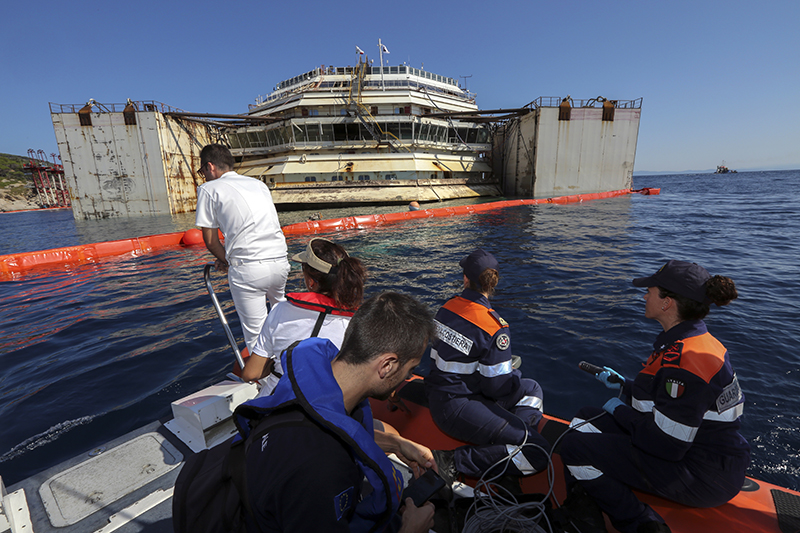
In the management of the Concordia shipwreck, the initial operations focuses on fuel recovery, an effort that begins one month after the accident and is completed on March 24, 2012, and on the collection and disposal of waste both inside the vessel and on the seabed.
The plan for the removal and salvage of the wreck is approved on May 15, 2012, based on technical guidelines established by a designated committee. This complex, multi-phase process begins in the summer of 2012 and ends with the Concordia’s return to the Port of Genoa on July 27, 2014.
The project for managing waste found inside the ship or on the seabed includes the collection and disposal of floating and bulky materials, sewage, chemicals, and oils. Before the wreck is rotated, wastewater and floating materials are removed, and caretaking operations—namely, activities aimed at cleaning the seabed of materials that have leaked from the ship—are initiated.
The fuel recovery, or debunkering, plan forms part of the environmental protection measures. The plan is carried out on behalf of Costa Cruises by Smit Salvage, in a joint venture with Neri. The operation involves removing fuel from the 15 tanks and the engine room in two main phases: drilling and flanging of the tanks, followed by pumping out the fuel (defueling).
Operations begin with the six external tanks, which contain approximately 67% of the fuel, then proceed to the nine internal tanks—bringing the total removal to 84% of the fuel—and conclude with operations in the engine room. A residual amount of fuel remains in the tanks, as it is inaccessible. From February 12 to March 24, 2012, a total of 2,042.5 cubic meters of hydrocarbons was extracted.
The selection of the project for the removal of the Concordia is entrusted to a technical committee established by Costa Cruises and composed of representatives from Costa, Fincantieri, the RINA Group, Carnival Corporation, London Offshore Consultants, and industry experts, including academics. The committee develops the technical guidelines for the removal of the hull and, on February 1, 2012, submits them to ten specialized companies for the preparation of an operational plan.
Of the six proposals submitted to Costa Cruises, on April 21, 2012, the committee approves the one put forward by the consortium formed by the Italian company Micoperi and the American company Titan Salvage, as it meets the required criteria: full removal of the wreck, maximum operational safety, minimal environmental impact, and the protection of the island’s tourism and economic activities. The removal plan is subsequently approved by a conference of the relevant authorities on May 15, 2012.
The project involves an initial phase of anchoring and stabilizing the wreck, followed by the construction of a temporary artificial seabed and the installation of caissons on the ship’s emerged side. Once these operations are complete, the Concordia is prepared for rotation. After rotation, caissons are also installed on the side that was previously submerged. With all 30 caissons installed, the ship is then ready to be refloated and transported to the dismantling site.
The ship’s rotation, or parbuckling. In the summer of 2012, preparations for the ship’s rotation begin. By November 2012, the wreck is secured with anchors and stabilized. In the summer of 2013, the artificial seabed is prepared, and eleven caissons are installed on the above-water side of the wreck. In July 2013, operations begin to pump water out of the ship, one of the measures planned to limit the risk of pollution from potential spills.
The parbuckling operation begins on September 16, 2013, at 9:00 a.m. and is successfully completed 19 hours later. The Concordia, once again upright, is placed on six underwater steel platforms, which are positioned to provide a stable base. In December, work to winterize and secure the ship is completed. The Concordia is thus ready to withstand even severe weather conditions during the winter season.
Refloating the ship. Operations to install the 15 caissons on the previously submerged side, as well as the remaining four on the opposite side, begin in April and are completed on July 3, 2014. The 30 caissons, initially filled with water, are then gradually emptied, creating the buoyancy needed to refloat the hull.
The refloating process consists of four phases:
▪ Partial refloating, followed by moving the wreck 30 meters eastward;
▪ Connecting and tensioning the chains and cables, and positioning the caissons on the starboard side in their final positions;
▪ The actual refloating, with water being pumped out of the caissons one deck at a time until the final position is reached;
▪ The departure maneuver toward the port of Genoa.
During the refloating operations, seawater is continuously monitored by ARPAT—the Regional Agency for Environmental Protection of Tuscany—and ISPRA—the National Institute for Environmental Protection and Research—with water samples collected at the sites where the main activities are taking place. To monitor seawater quality, the Civil Protection Department also activates satellite-based monitoring, with the support of specialized centers (ASI, DST UniFI, and the CIMA Foundation), as well as the GIO EMS Rush service—the GMES Initial Operation Emergency Management Service, part of the Copernicus program. An aircraft equipped with infrared cameras, operated by the Port Authority, is deployed to detect any oil pollution in the waters surrounding the wreck.
Once the removal is complete, work begins to clean the seabed and restore the marine flora.